Ledbury walk
Wednesday June 13th 2012
A walk looking at Ledbury building materials and the Wedlock and Aymestry limestone Hills. Much of this route was based on the leaflet 'Ledbury: Walk through the past for a healthy future'. This is one of four Health Walks researched and written by the Herefordshire and Worcestershire Earth Heritage Trust.
Report on the walk
On June 13th a group of us enjoyed a walk around Ledbury Town and the hills immediately behind it. We were led by Elizabeth Staley, who with her extensive knowledge made it very informative and interesting. We were a mixed bunch, from the obviously knowledgeable to those, like myself, with very limited knowledge but a keen interest in geology.
The town of Ledbury sits on a fault line running north to south, with sandstone to the west and limestone forming the hills to the east. Lots of sediments were brought down from Wales during the late Silurian and Carboniferous period, forming various sandstones and mudstones on the west side. Later, with complex folding and movement along the fault line, the limestone re-emerged in the hills to the east.
We started off in the town where a lot of the buildings are very old. St. Katharine's Hall was originally a mediaeval hospital, built with various sandstones. The public library (the Barrett Browning Building) is built from Wenlock Limestone, the main limestone of the local hills to the east, containing many fossils, mainly brachiopods, crinoids and corals.
The main road through Ledbury is Saxon, if not earlier, and during this period it was a busy trading point. The present market house was built in 1617 but the original trading licence was granted to the bishop in 1132. Church Lane is a wonderful example of original limestone cobbles and timber-framed buildings with wattle and daub inserts. The Ledbury heritage centre was built there in c1480, probably by wool merchants. It is an excellent example of this and has a huge chimney inside called a smoke bay, used for smoking meats etc. Later a grammar school was set up in this building. The church, the main frontage of which is Norman, is built of various sandstones, brought in from local quarries. For example parts of the Bell Tower are of the yellow Downton Castle Sandstone. Ridges seen on some sandstone blocks intrigued us. Several explanations were put forward but with no definite conclusion.
Now off to the hills. At the first quarry (SO 716 377) we visited, the visible limestone beds were dipping very steeply down and, as they were relatively narrow beds, would have made very good walling stones. It was also interesting to see a disused lime kiln nearby.
We then walked on to Upper Hall Farm Quarry. This consists of Wenlock Limestone. It has quite small rocks with shale between the limestones. About half way up the quarry face shale becomes predominant. This is the Lower Ludlow Shale.
Our walk took us through a delightful wild flower conservation meadow, what a lovely sight to see! Then on to Cut Throat Lane, apparently named for the goings-on during the Civil War! We turned left onto a track which converges with the Aymestry Limestone ridge of Dog Hill. Along here we saw an exposure of the Aymestry Limestone. There was a large old yew tree sat atop it. The Ledbury Fault here had dragged the limestone down almost vertically, again it was quite small blocks.
We finished our walk along Church Street, which was the old packhorse route to Worcester. Our grateful thanks again to Elizabeth Staley and her able assistant Liz Daniel for an excellent morning -— the weather was kind to us too!
Diane Davies
Pictures

Looking at the Wenlock Limestone blocks used for the public library (the Barrett Browning Building).

Fossils (mainly brachiopods and crinoids) in the Wenlock Limestone of the public library.
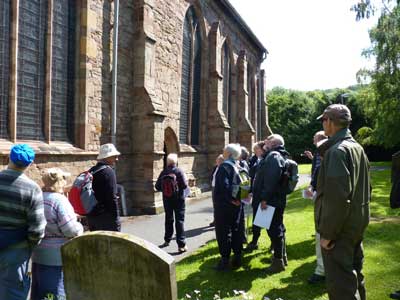
Looking at the sandstones of the church.
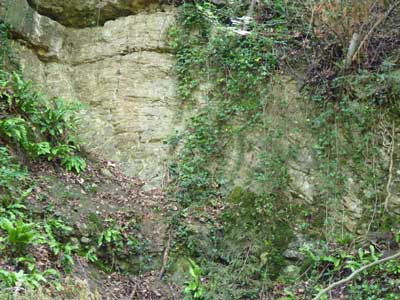
Folded Wenlock beds in the first quarry.

Looking at the Wenlock Limestone beds and lower Ludlow Shales in Upper Hall Farm Quarry.